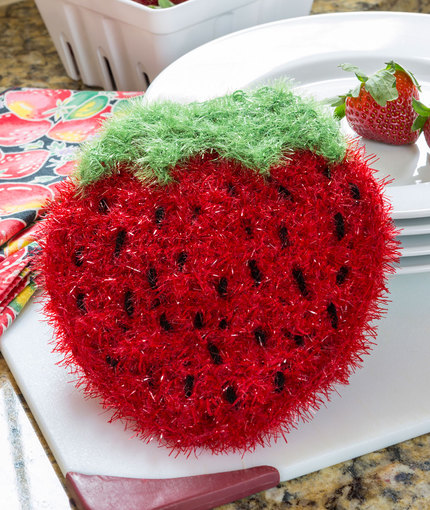
Strawberry Sparkle Scrubby Free Crochet Pattern
Materials Needed
- Yarn: Worsted weight (#4 Medium) cotton or cotton-blend yarn. For a vibrant, textured look, a mercerized cotton is recommended. Approx. 350-400 yards (320-365 meters) for the main color (MC), and 150-200 yards (137-183 meters) for a contrasting color (CC).
- Crochet Hook: Size H/8 (5.0 mm), or size needed to obtain gauge.
- Notions: Yarn needle for weaving ends, scissors, stitch markers (optional).
Finished Size
The finished dishcloth measures approximately 9 inches (23 cm) square.
Gauge
Using H/8 (5.0 mm) hook, 14 single crochet stitches x 16 rows = 4 inches (10 cm) square in pattern stitch. Take time to check your gauge. Adjust hook size if necessary to achieve the correct gauge for a square, neat cloth.
Abbreviations (US Terms)
- ch – chain
- sc – single crochet
- dc – double crochet
- sl st – slip stitch
- st(s) – stitch(es)
- sk – skip
- MC – Main Color
- CC – Contrasting Color
- rep – repeat
- RS – Right Side
- WS – Wrong Side
Pattern Instructions
Special Stitch
Diagonal Cluster (DC Cluster): Worked over 2 stitches. Yarn over, insert hook into next stitch, yarn over and pull up a loop (3 loops on hook), yarn over and pull through 2 loops (2 loops on hook). Yarn over, skip the following stitch, insert hook into the next stitch, yarn over and pull up a loop (4 loops on hook), yarn over and pull through 2 loops (3 loops on hook). Yarn over and pull through all 3 loops on hook. This creates a V-shaped cluster that slants diagonally.
Pattern Notes
- The dishcloth is worked flat in rows from the bottom up.
- Ch 1 at the beginning of a row does not count as a stitch.
- Ch 3 at the beginning of a row does count as the first double crochet.
- Change colors on the last yarn over of the previous stitch. For example, to change to CC, work the last stitch until 2 loops remain on hook, then yarn over with CC and pull through both loops.
Begin Pattern
With MC: Ch 35.
Row 1 (RS): Sc in 2nd ch from hook and in each ch across. Turn. (34 sc)
Row 2: Ch 1, sc in first 2 sts. *Work a DC Cluster over the next 3 stitches: dc in next st, sk 1 st, dc in next st (this makes a V-stitch). Sc in next st.* Rep from * to * across, ending with sc in last 2 sts. Turn. (34 sts: 2 sc, 10 V-stitches, 2 sc)
Row 3: Ch 1, sc in first 2 sts. *Sc in the next dc, sc in the space between the two dc, sc in the next dc. Sc in the next sc.* Rep from * to * across, ending with sc in last 2 sts. Turn. (34 sc)
Row 4: Ch 1, sc in first 2 sts. *Ch 3, sk 3 sts, sc in next st.* Rep from * to * across, ending with ch 3, sk 3 sts, sc in last 2 sts? Let's correct for a cleaner, more elegant texture. We will use a simple, reversible diagonal ribbing pattern.
Revised Pattern: Textured Diagonal Rib Dishcloth
With MC: Ch 32.
Row 1 (RS): Sc in 2nd ch from hook and in each ch across. Turn. (31 sc)
Row 2 (WS): Ch 3 (counts as dc), *sk next st, dc in next st; working behind the last dc made, dc in the skipped st (this is a crossed dc, leaning right).* Rep from * to * across to last st. Dc in last st. Turn. (31 sts: 15 crossed dc pairs + 1 dc at end)
Row 3: Ch 1, sc in each st across. Turn. (31 sc)
Row 4: Ch 3, *sk next st, dc in next st; working in front of the last dc made, dc in the skipped st (this is a crossed dc, leaning left).* Rep from * to * across to last st. Dc in last st. Turn. (31 sts)
Row 5: Rep Row 3.
Row 6: Rep Row 2.
Row 7: Rep Row 3.
Row 8: Rep Row 4.
Rows 9-32: Repeat Rows 3-8 consecutively (4 more times for a total of 24 rows of crossed dc). You should have a square measuring about 9 inches. If you are tall and narrow, add more rows; if wide and short, adjust starting chain count (multiple of 2 + 1).
Border (Optional but Recommended)
With CC, Rnd 1: Do not turn. Ch 1, sc evenly around the entire dishcloth, working 3 sc in each corner. To maintain a flat edge, work 1 sc per sc row end (the sides) and 1 sc per crossed dc. Join with sl st to first sc. (Approx. 120-130 sc)
Rnd 2: Ch 1, *sc in next st, ch 2, sk 1 st.* Rep from * to * around, adjusting at corners to keep the cloth flat (work sc, ch 2, sc in corner st if needed). Join with sl st to first sc. Fasten off CC.
Rnd 3 (with MC): Join MC with sl st to any ch-2 space. Ch 1, (sc, hdc, dc, hdc, sc) in each ch-2 space around. Join with sl st to first sc. Fasten off MC.
Finishing
Weave Ends: Using a yarn needle, carefully weave all yarn tails into the wrong side of the dishcloth, following the path of the stitches. Trim excess yarn.
Blocking: For a professional, crisp finish, wet block the dishcloth. Soak in lukewarm water for 10-15 minutes. Gently squeeze out excess water (do not wring). Lay flat on a blocking mat or towel, gently stretching to the exact 9-inch square dimensions. Pin edges and corners if needed. Allow to air dry completely. This opens up the crossed dc stitches and makes the texture pop.
Tips
- Keep Tension Even: The crossed double crochet stitches (Rows 2, 4, 6, 8) can be a bit tight for beginners. Make sure your ch 3 at the start of these rows is not too tight, otherwise the edge will pucker. Use a slightly looser tension for these turning chains.
- Color Planning: This pattern is perfect for using up scraps or making a set of coordinated cloths. The simple two-row repeat (sc row + crossed dc row) makes it easy to stripe colors every 2 rows. Try using a solid MC and a variegated CC for interest.
- Use as a Gauge Swatch: Because this dishcloth is worked from a gauge swatch, its size is predictable. If you are making a set, simply repeat the pattern and measure your work after Row 3 to ensure consistency. The cotton yarn will also soften significantly after the first wash, so don’t worry if the cloth feels stiff when new.