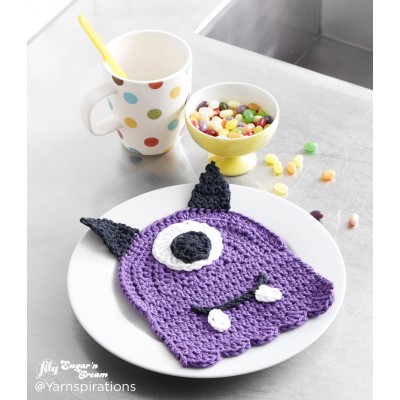
Scary Gary Crochet Dishcloth
Materials Needed
- Yarn: Approximately 350-400 yards of worsted weight (#4 Medium) cotton or cotton-blend yarn. A smooth, non-splitting yarn in a light or solid color is recommended for stitch definition. Suggested yarn: Lily Sugar 'n Cream, Lion Brand Kitchen Cotton, or equivalent.
- Crochet Hook: Size H/8 (5.0 mm), or size needed to obtain gauge.
- Notions: Yarn needle for weaving ends, scissors, stitch markers (optional).
Yarn Amounts: For a standard square dishcloth measuring approximately 8" x 8", you will need roughly 100-110 yards of worsted weight cotton. For a set of four matching dishcloths, purchase 4 skeins (or 400+ yards) of the same yarn. The pattern is easily scalable by repeating the 8-row pattern repeat.
Gauge
4 inches square = 16 stitches (sts) x 12 rows in the main stitch pattern (shown below).
To check gauge: Chain 18. Work rows 1-4 of the pattern instructions. Measure the center 4 inches of your swatch. Adjust hook size up or down if necessary to match gauge. Getting gauge is essential for the finished size to be accurate, especially if you plan to make multiple matching cloths.
Abbreviations (US Terms)
- ch – chain
- sc – single crochet
- hdc – half double crochet
- dc – double crochet
- sl st – slip stitch
- st(s) – stitch(es)
- sk – skip
- sp – space
- RS – right side
- WS – wrong side
- rep – repeat
- beg – beginning
- rem – remaining
- yo – yarn over
Pattern Instructions
Note: This pattern creates a textured, absorbent dishcloth with a lovely woven look. The stitch pattern is a variation of the "Linen Stitch" or "Moss Stitch," worked in rows with a simple, repetitive rhythm. Ch 1 at the beginning of rows does not count as a stitch unless specified otherwise.
Foundation Row:
Ch 23 loosely. (This creates a foundation chain for a cloth approximately 8 inches wide. For a larger cloth, chain an odd number of stitches.)
Row 1 (RS):
Sc in 2nd ch from hook (skipped ch does not count as a st). *Ch 1, sk next ch, sc in next ch.* Rep from * to * across. You will have 11 sc stitches and 11 ch-1 spaces. Turn.
Row 2 (WS):
Ch 1 (does not count as a st here and throughout). Sc in first sc (the same st as the ch-1). *Ch 1, sk the ch-1 sp, sc in the next sc (the sc from the previous row).* Rep from * to * across. End with a sc in the last sc of the row. Turn.
Row 3:
Ch 1. Sc in first sc. *Ch 1, sk the ch-1 sp, sc in the next sc.* Rep from * to * across. End with sc in last sc. Turn.
Row 4:
Repeat Row 3. This establishes the pattern. You will continue repeating Row 3 for the body of the cloth until you have a total of 30 rows (or until the piece measures approximately 8 inches from the foundation chain, ending after completing a row that ends on the WS).
Optional Border Instructions:
For a neat, finished edge, add a simple single crochet border around the entire cloth. Do not turn after the last row. Instead, ch 1.
- Side 1 (top edge): Work 1 sc in each sc and 1 sc in each ch-1 sp across the top edge. (You should have 22 sc across.)
- Corner 1: Work 2 sc in the corner space (the side of the last row).
- Side 2 (left edge): Work 1 sc in the end of each row up the side. With 30 rows, you will have approximately 30 sc. Work evenly, placing one sc per row end.
- Corner 2: Work 2 sc in the corner space.
- Side 3 (bottom edge): Working into the foundation chain, work 1 sc in each ch across. (22 sc.)
- Corner 3: Work 2 sc in the corner space.
- Side 4 (right edge): Work 1 sc in the end of each row up the side (30 sc).
- Corner 4: Work 2 sc in the corner space.
- Join with a sl st to the first sc of the border round. Fasten off, leaving a 6-inch tail for weaving.
Alternate Finishing (No Border):
If you prefer a simpler edge, simply fasten off after the last row of the body. Weave in the starting tail from the foundation chain and the ending tail securely. The edges will naturally have a slight scalloped look due to the ch-1 spaces, which is also charming and functional.
Finishing
- Weave in Ends: Thread the yarn tail from fastening off (and the starting tail from the foundation chain) onto a yarn needle. Weave the tail through the back loops of several stitches in a zigzag pattern, going back and forth to secure. Trim the excess yarn close to the fabric. Do not knot if you can avoid it; a good weave is secure enough for dishcloths that will be washed frequently.
- Blocking (Optional but Recommended): Fill a sink or basin with lukewarm water and a drop of mild soap (like dish soap or wool wash). Submerge the dishcloth and gently squeeze to wet it thoroughly. Let it soak for 10-15 minutes. Drain the soapy water and rinse the cloth in cool water until all soap is gone. Gently squeeze out excess water—do not wring. Lay the cloth flat on a dry towel, roll the towel up to remove more moisture, then unroll and shape the cloth to its final dimensions. Allow it to air dry completely. Blocking evens out the stitches and sets the shape, resulting in a professional-looking finished piece.
- Final Check: Once dry, inspect the cloth for any loose ends or uneven stitches. Trim any stray threads. Your textured dishcloth is now ready to use or gift!
Tips
- Count Your Stitches Frequently: The Linen Stitch is very rhythmic, but it's easy to accidentally add or drop a stitch at the row ends. After the first few rows, you should have 11 sc stitches and 11 ch-1 spaces. If you notice the edge is slanting, you may have added an extra stitch (by working into the ch-1 space instead of the sc) or dropped a stitch (by skipping the last sc). Count every other row to stay on track.
- Use a Stitch Marker for the Foundation Chain: When working into the foundation chain, it can be easy to lose your place, especially if the chain is tight. Place a stitch marker in the 1st, 11th, and 22nd chain to help you keep count. This is especially helpful if you are a beginner or if you are using a dark-colored yarn where the stitches are harder to see.
- Cotton Yarn is Best for Dishcloths: Cotton is highly absorbent, durable, and machine washable. Avoid using acrylic or wool for dishcloths, as they can melt under high heat (from hot water or a dryer) or may not be absorbent enough. A cotton/linen blend is also an excellent choice for extra texture and durability. If you plan to use the cloth for scrubbing, consider a cotton yarn with a slight twist, like a mercerized cotton, which is stronger and more resistant to fraying.