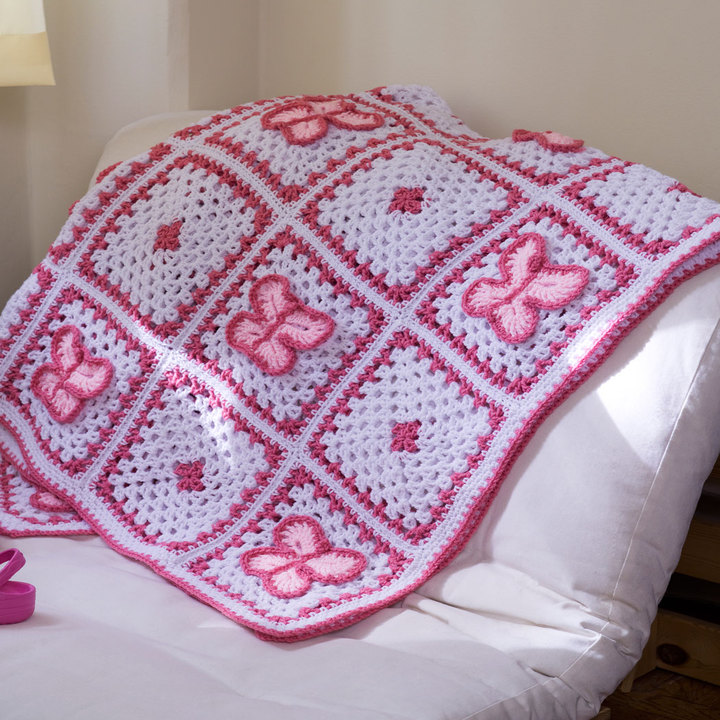
Free Pattern for a Crochet Butterfly Throw
Materials Needed
Yarn: Approximately 500 yards (457 meters) of worsted weight (Category 4) cotton or cotton-blend yarn. For a standard 12" x 12" square, you will need roughly 200 yards. For the full blanket size (36" x 36"), you will need approximately 500 yards.
- Suggested Yarn: Lily Sugar 'n Cream, Lion Brand 24/7 Cotton, or Paintbox Yarns Cotton Aran. Choose a light, solid color to best showcase the stitch texture.
- Sample uses: Kitchen Cotton (for dishcloths) or Soft Cotton (for home decor).
Hook: Size H/8 (5.0 mm) crochet hook, or size needed to obtain gauge.
Notions:
- Tapestry needle for weaving ends
- Scissors
- Stitch markers (optional, for counting rounds)
Finished Size
- Dishcloth / Small Square: 10" x 10" (25 cm x 25 cm) – use 1 skein (approx. 120 yards).
- Pillow Cover (front panel only): 18" x 18" (46 cm x 46 cm) – use approx. 300 yards.
- Lap Blanket / Throw: 36" x 36" (91 cm x 91 cm) – use approx. 500 yards.
- Full Blanket: 48" x 60" (122 cm x 152 cm) – use approx. 1000 yards (2 large skeins).
Gauge
4" x 4" (10 cm x 10 cm) = 14 stitches (sts) x 10 rows in the Basket Weave Pattern (as described below).
To check gauge: Ch 18. Work rows 1–3 of the Basket Weave pattern for 12 rows. Measure the center 4". If you have more than 14 sts, try a larger hook. If fewer, try a smaller hook.
Abbreviations (US Terms)
- ch – chain
- sc – single crochet
- dc – double crochet
- fpdc – front post double crochet (yarn over, insert hook from front to back around the post of the stitch below, yarn over, pull up loop, complete as dc)
- bpdc – back post double crochet (yarn over, insert hook from back to front around the post of the stitch below, yarn over, pull up loop, complete as dc)
- st(s) – stitch(es)
- sk – skip
- rep – repeat
- RS – right side
- WS – wrong side
Pattern Instructions
General Notes
- The pattern is worked in rows (back and forth) to create a flat, woven texture.
- The basket weave effect is created by alternating groups of fpdc and bpdc stitches over an even number of stitches.
- Each "block" of texture is 4 stitches wide and 4 rows tall. To adjust size, add or subtract multiples of 8 stitches (4 for fpdc, 4 for bpdc).
- Turning ch 2 counts as a dc stitch throughout.
Foundation Row (Row 0)
Ch a multiple of 8 + 2 (for the turning chain). For a 12" square, ch 42 (40 sts + 2). For a 36" blanket, ch 122 (120 sts + 2).)
Row 1 (RS): Dc in the 3rd ch from hook (the skipped 2 ch count as the first dc). Dc in each ch across. Turn. (You should have 41 dc for the 12" square, or 121 dc for the blanket.)
Basket Weave Pattern
Row 2 (WS): Ch 2 (counts as first dc). *Fpdc around the next 4 sts (work around the post of the dc from the previous row), bpdc around the next 4 sts; repeat from * across until 1 st remains. Dc in the top of the turning chain. Turn.
Row 3 (RS): Ch 2 (counts as first dc). *Bpdc around the next 4 sts (these are the sts you did fpdc into on the previous row), fpdc around the next 4 sts; repeat from * across until 1 st remains. Dc in the top of the turning chain. Turn.
Row 4 (WS): Repeat Row 2.
Row 5 (RS): Repeat Row 3.
This completes the first 4-row block. Now you will swap the pattern to create the woven checkerboard effect.
Row 6 (WS): Ch 2. *Bpdc around the next 4 sts, fpdc around the next 4 sts; rep from * across, dc in last st. Turn.
Row 7 (RS): Ch 2. *Fpdc around the next 4 sts, bpdc around the next 4 sts; rep from * across, dc in last st. Turn.
Row 8 (WS): Repeat Row 6.
Row 9 (RS): Repeat Row 7.
Repeat Rows 2–9 until your piece reaches the desired height. For a square dishcloth, repeat until you have roughly 10" of fabric. For a blanket, continue until you have 36" (or your desired length). End on a Row 5 or Row 9 (a RS row) for a clean finish.
Final Row (Edging Row)
After completing your last pattern row, do NOT turn. Ch 1, and sc evenly around the entire perimeter of the piece, working 3 sc in each corner. Sl st to the first sc to join. Fasten off and weave in ends.
Optional border: For a more decorative edge, work a round of (sc, ch 2, sc) in each corner, and a row of reverse sc (crab stitch) for a braided look.
Finishing
- Weave in ends: Using a tapestry needle, weave the yarn tails into the back of the stitches on the wrong side. Weave at least 2 inches (5 cm) to secure. Trim excess yarn.
- Blocking (recommended for even texture): Soak the finished piece in cool water for 15 minutes. Gently squeeze out excess water (do not wring). Lay flat on a towel, shape to desired dimensions (pin corners if needed), and allow to air dry completely. This step really opens up the post stitches and gives a crisp, woven look.
- For pillow covers: Fold the square in half (or make a second matching square). With RS together, sc along three sides. Turn RS out, insert pillow form, then close the fourth side with a slip stitch seam or a row of sc.
- For dishcloths: Simply weave ends, block lightly, and use. The textured side is great for scrubbing.
Tips
- Keep tension even on post stitches: Front post and back post double crochet can pull the fabric in if worked too tightly. Relax your grip and let the yarn flow freely. If you find your post stitches are hard to insert the hook into, try using a hook one size larger for just the post stitches (or work them slightly looser).
- Count your stitches every 4 rows: It's easy to accidentally add or drop a stitch when working post stitches because you might miss the first or last stitch. At the end of each 4-row block, count to ensure you still have the original number of stitches (e.g., 41 for the 12" square). If you lose a stitch, you can work an extra dc in the last stitch of the next row to correct.
- Use stitch markers to mark the first and last stitch of each row: Place a marker in the top of the turning chain (which counts as a dc) and another in the very last dc of the row. This is especially helpful on the WS rows when the texture makes it hard to see where the row ends.
- Customize the width easily: Want a rectangular blanket? Simply chain a multiple of 8 + 2 (e.g., 82 for 60" wide) and work until you run out of yarn. The pattern scales perfectly with no math required.