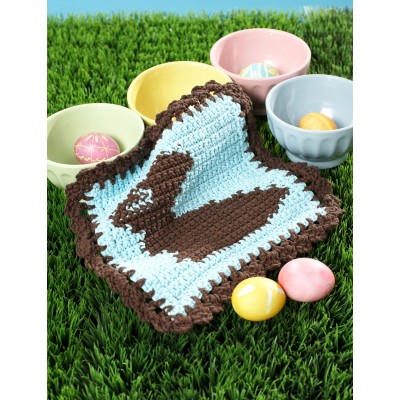
Chocolate Bunny Dishcloth Free Crochet Pattern
Materials Needed
- Yarn: 100% Cotton, worsted weight (Category 4). Approximately 300-350 yards for the main color (MC) and 150-200 yards for the contrasting color (CC). A soft, absorbent cotton like Lily Sugar'n Cream or Lion Brand Kitchen & Cotton works best.
- Crochet Hook: Size I/9 (5.5 mm), or size needed to obtain gauge.
- Notions: Yarn needle, scissors, stitch markers (optional), measuring tape.
Gauge
In pattern stitch (after blocking): 16 stitches x 18 rows = 4 inches (10 cm). This is achieved with a slightly smaller hook than recommended for worsted weight to ensure a tight, dense fabric for durability.
Abbreviations (US Terms)
- ch: chain
- sl st: slip stitch
- sc: single crochet
- hdc: half double crochet
- dc: double crochet
- fpdc: front post double crochet
- bpdc: back post double crochet
- sk: skip
- st(s): stitch(es)
- rep: repeat
- RS: right side
- WS: wrong side
- MC: main color
- CC: contrasting color
Pattern Instructions
Finished Size
Approximately 18 inches wide x 18 inches long (square dishcloth or small decorative pillow front). To make a larger blanket, simply chain any multiple of 8 + 3, and repeat rows until desired length.
Special Stitch: Diagonal Texture Cluster (DTC)
Worked over 2 stitches. Yarn over, insert hook into next stitch, yarn over and pull up a loop (3 loops on hook). Yarn over, insert hook into the following stitch, yarn over and pull up a loop (5 loops on hook). Yarn over and pull through all 5 loops. Chain 1 to close the cluster. This creates a raised, slanted texture.
Pattern Body (Worked Flat, Back and Forth)
Foundation Row (RS): With MC, ch 35. Sc in 2nd ch from hook and in each ch across. Turn. (34 sc)
Row 1 (WS): Ch 1 (does not count as a st here and throughout unless noted). Sc in first 3 sts. Ch 1, sk next st, sc in next 3 sts. Rep from * to last 2 sts. Sc in last 2 sts. Turn. (34 sts: 26 sc + 8 ch-1 spaces)
Row 2 (RS): Ch 1. Sc in first 2 sts. Work a DTC over the next 2 sts (the ch-1 space and the next sc). Ch 1, sk next st (the next sc from previous row). Rep from * across, ending with sc in last 2 sts. Turn. (You will have 8 DTCs, each separated by ch-1 spaces, with sc borders on each side.)
Row 3 (WS): Ch 1. Sc in first 2 sts. Sc in next ch-1 space, sc in top of next DTC, sc in next ch-1 space. Rep from * across, ending with sc in last 2 sts. Turn. (34 sc)
Row 4 (RS): Ch 1. Sc in first 3 sts. Ch 1, sk next st, sc in next 3 sts. Rep from * to last 2 sts. Sc in last 2 sts. Turn. (This mirrors Row 1, creating the offset for the diagonal pattern.)
Row 5 (WS): Ch 1. Sc in first 2 sts. Work a DTC over the next 2 sts (the ch-1 space and the next sc). Ch 1, sk next st (the next sc from previous row). Rep from * across, ending with sc in last 2 sts. Turn. (Again, 8 DTCs, now shifted by one stitch, creating a zigzag effect.)
Row 6 (RS): Ch 1. Sc in first 2 sts. Sc in next ch-1 space, sc in top of next DTC, sc in next ch-1 space. Rep from * across, ending with sc in last 2 sts. Turn. (34 sc)
Color Change & Pattern Repeat: Repeat Rows 1-6 for the pattern, but every 6 rows, you will switch colors. Work 6 rows with MC, then 6 rows with CC. Continue alternating until you have worked a total of 72 rows (12 full color stripes of 6 rows each), or until your piece measures 18 inches from the foundation edge, ending after a Row 6 (sc row).
Last Row (WS): If you ended on an even-numbered row (Row 6), do not turn. Cut yarn, leaving an 8-inch tail. Weave in ends. If you ended on an odd-numbered row, work one final sc row across (ch 1, sc in each st across) to even out the edge.
Finishing
Border (Optional but Recommended)
With RS facing, attach CC yarn to any corner. Work a round of single crochet evenly around the entire piece, working 3 sc in each corner. Join with sl st to first sc. Fasten off.
Weaving Ends
Weave in all yarn tails securely using a yarn needle. Weave in the opposite direction of the stitches (e.g., weave horizontally across the sc rows) to prevent unraveling. Trim excess yarn close to the work.
Blocking
For a dishcloth, you may skip blocking. For a pillow or blanket, wet block the piece. Soak it in lukewarm water for 15 minutes, gently squeeze out excess water (do not wring). Lay flat on a blocking mat or towel, pin to the correct dimensions (18" x 18" for a square), and allow to dry completely. This will even out the stitches and give a professional look.
Tips
- Tension is Key: The DTC stitch can be tricky if your tension is too loose. Keep your stitches snug but not tight. If your DTCs look messy, try using a slightly smaller hook (like a J/10 or 6.0 mm) just for the cluster part of the row, then switch back to the I/9 for the sc rows.
- Count Your Clusters: After each DTC row (Rows 2 and 5), count your clusters. You should always have 8 clusters per row. This ensures the diagonal pattern stays aligned and your piece remains square. Use stitch markers at the beginning and end of each cluster to help you see the pattern.
- Color Planning: For a home decor piece, choose a main color that matches your room’s palette and a contrasting color that pops. A solid MC with a variegated CC can create a beautiful, textured effect. If using as a dishcloth, avoid dark colors that might bleed onto light dishes.